01
The business
A finance lead-generation team running Meta Ads campaigns for business loans, doctor loans, and loan against property (LAP) products in India. Campaign budgets ranged from approximately ₹500 to ₹1,000 per day per campaign. The team was using Meta's lead generation objective to collect enquiries directly from the platform.
On the surface, everything looked fine. Leads were coming in. Cost per lead looked reasonable. Meta was delivering.
02
Cheap leads. Almost no qualified ones.
The campaigns were generating leads at a seemingly acceptable cost. Over one documented period, the account produced 45 leads at ₹14,611 total spend, giving a CPL of ₹324.68. By most dashboard metrics, this looked like a healthy lead-generation campaign.
But the sales team reported a very different reality.
Only approximately 8 to 13 percent of the leads were genuinely qualified or progressing through the pipeline. The rest were either unreachable, uninterested, or fundamentally ineligible for the financial products being advertised.
The most telling signal: 76% of leads self-declared annual turnover below ₹50 lakhs. The loan products required a minimum of ₹1 crore.
The campaigns were not failing to generate leads. They were failing to generate the right leads.
"Efficient ad delivery and lead qualification are two different problems."
This is the gap Cofoundr was used to investigate.
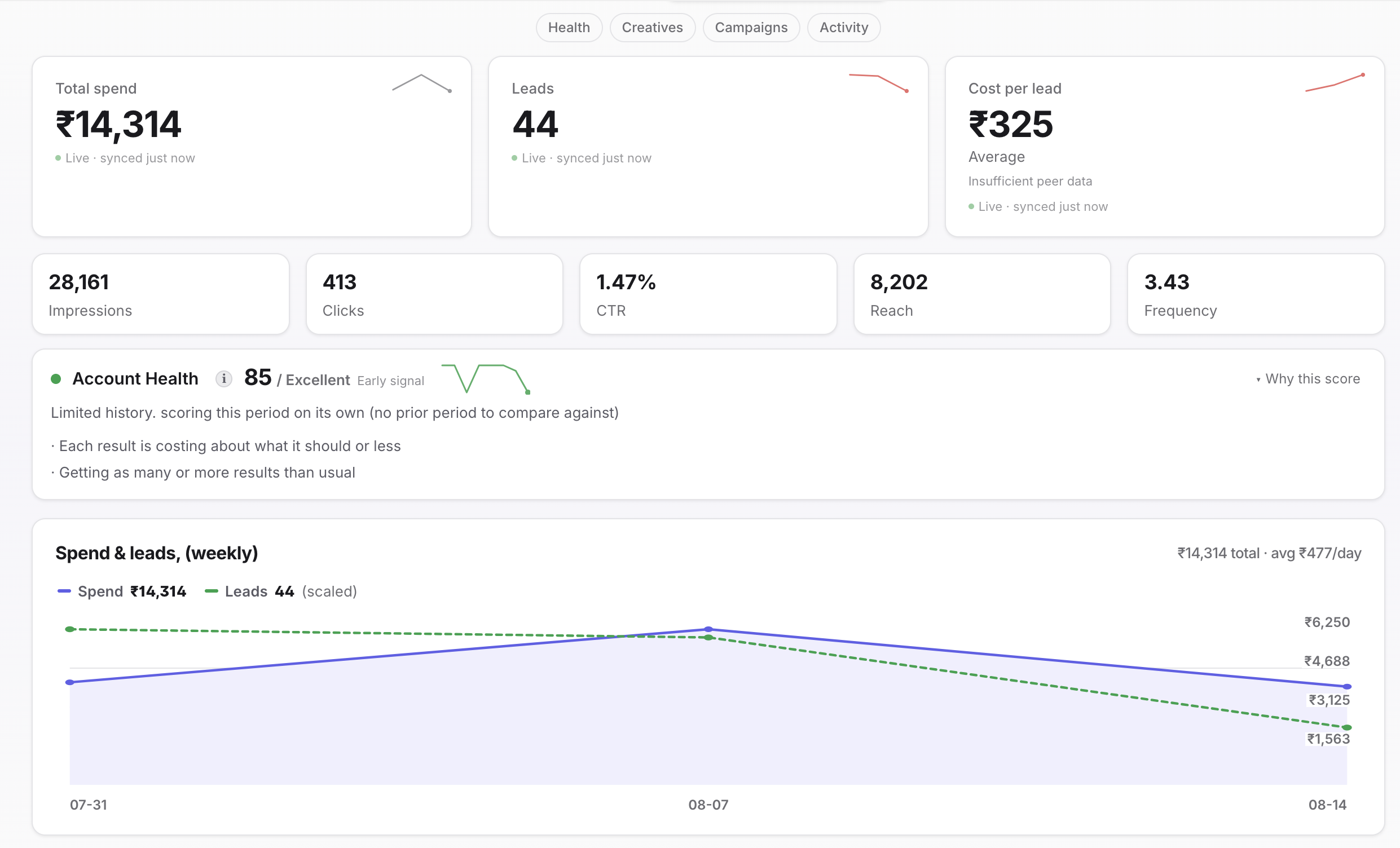
Cofoundr overview dashboard for the account during the documented period.
03
What Cofoundr saw that the dashboard did not show
Using Cofoundr's MCP connection to the live Meta account, the team investigated the campaigns at the configuration level. Not just performance metrics, but targeting settings, audience expansion rules, lead form logic and account-level constraints. This is what an AI advertising platform reveals when it has access to the full campaign structure.
Five issues were identified.
What Cofoundr saw:
A campaign stopped generating leads entirely during a specific period.
What it meant:
An overdue payment triggered an account restriction, pausing delivery without a clear alert in the standard dashboard view.
Why it mattered:
The team assumed low delivery was a performance issue. It was actually a billing issue. Without checking at the account level, the real cause would have remained hidden.
What Cofoundr saw:
Meta's targeting system contained relevant Job Title, Education and Industry categories that were not visible through a basic interest search in Ads Manager.
What it meant:
The team had been using broad interest targeting because the precise categories did not appear in the standard search. Cofoundr's MCP access revealed targeting options the team did not know existed.
Why it mattered:
Better targeting categories meant campaigns could reach people with the right professional and financial profiles, rather than broad audiences loosely associated with financial topics.
What Cofoundr saw:
The Doctor Loan campaign had precise targeting configured for medical professionals. However, Advantage+ Audience expansion was enabled, allowing Meta to deliver ads outside the specified audience.
What it meant:
The targeting itself was not the problem. The override was. Meta was expanding delivery beyond doctors to a broader audience that was cheaper to reach but far less likely to be eligible.
Why it mattered:
Without inspecting the ad set configuration at the API level, this expansion would not have been visible in a standard campaign review.
What Cofoundr saw:
Multiple overlapping campaigns were targeting the same geography and audience segments.
What it meant:
The campaigns were potentially competing against each other in the auction, which can increase costs and fragment delivery optimization.
Why it mattered:
Consolidating or separating audiences properly would allow Meta's delivery system to optimize more effectively.
What Cofoundr saw:
Some financial services campaign and lead form configurations behaved differently depending on the Special Ad Category setup.
What it meant:
Certain targeting and form features were restricted or behaved differently under the financial services category, affecting how leads were collected.
Why it mattered:
Understanding these constraints was necessary to design campaigns that worked within Meta's rules while still qualifying leads effectively.
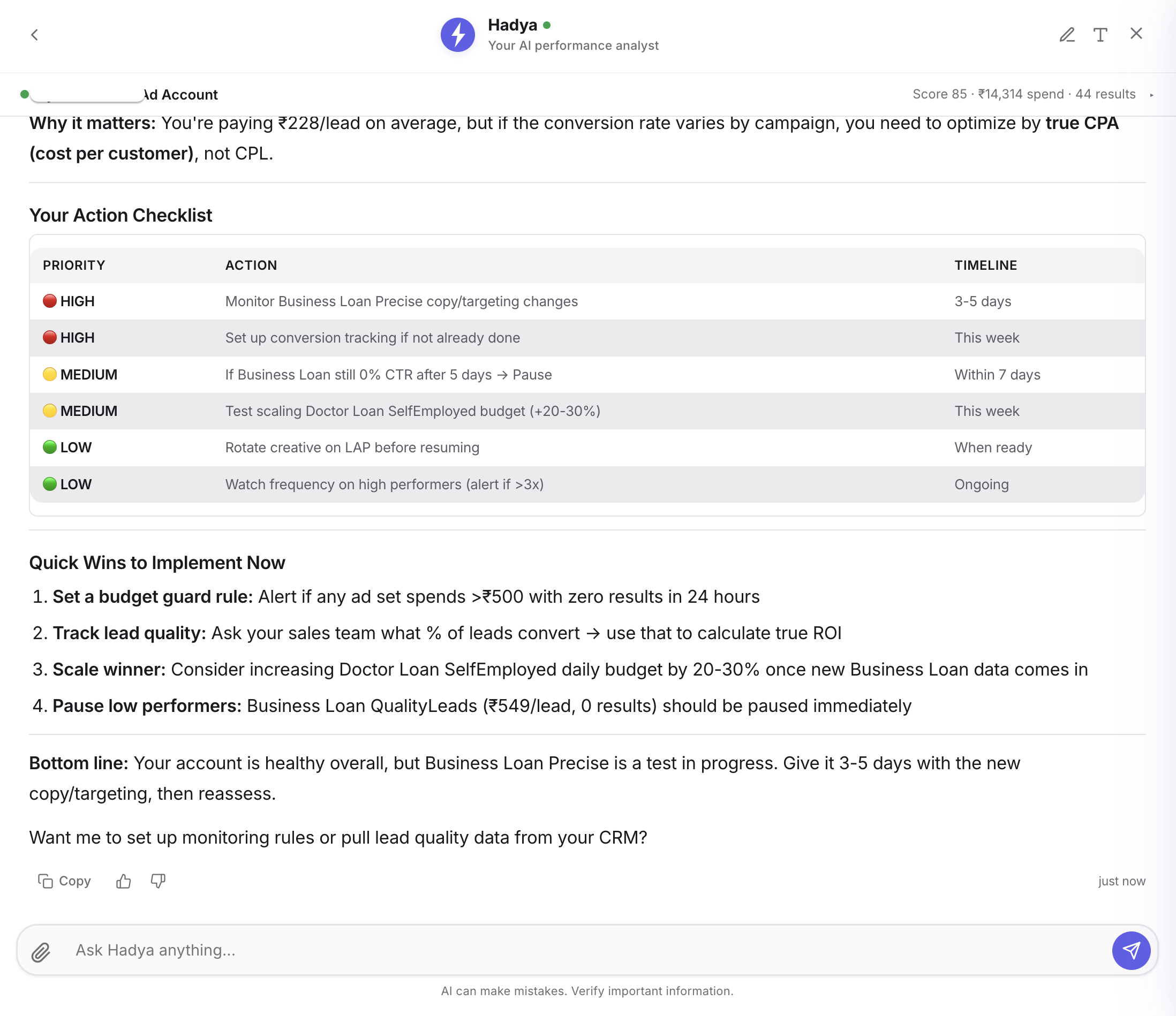
Hadya's investigation and action checklist for the account. Captured in September 2026, before the app redesign.
04
The Doctor Loan example
This campaign illustrates the difference between what a dashboard shows and what actually happened.
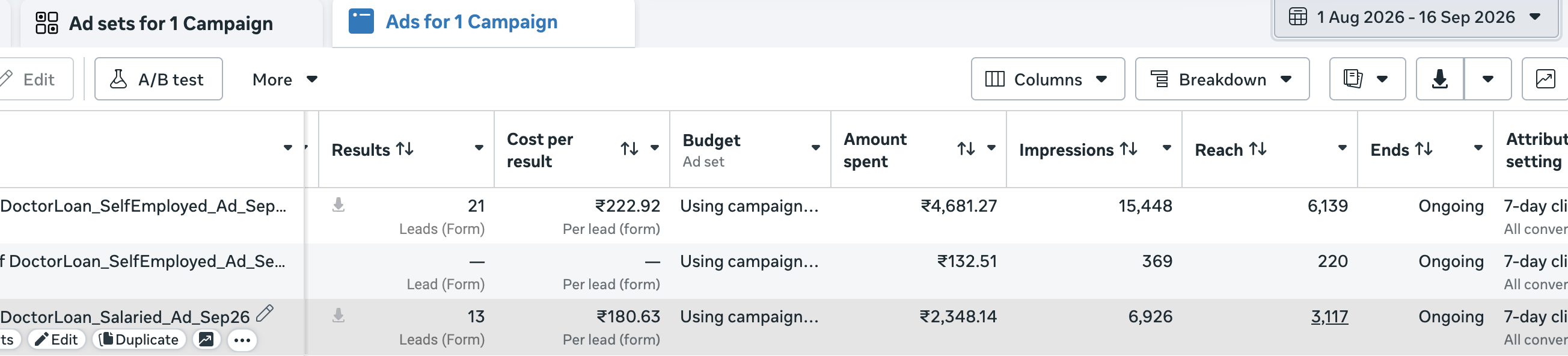
The Doctor Loan campaign had healthy click volume and a cost per lead around ₹190 to ₹260. On paper, it was the best performing campaign in the account.
But the sales team reported the first batch contained zero genuine doctors.
Using Cofoundr MCP, the team inspected the ad set targeting configuration. The targeting was correctly set to medical professionals. However, Advantage+ Audience expansion was enabled at the ad set level, and Meta was using that permission to deliver the ads to a broader, cheaper audience.
The targeting was not the problem. The override was.
"This is why an AI operating layer needs access to campaign configuration, not just performance metrics. The dashboard said the campaign was working. The configuration said otherwise."
Doctor Loan campaign ad sets in Meta Ads Manager.
05
What actually moved the needle
Two changes had the most impact on lead quality.
1. Conditional-logic lead forms
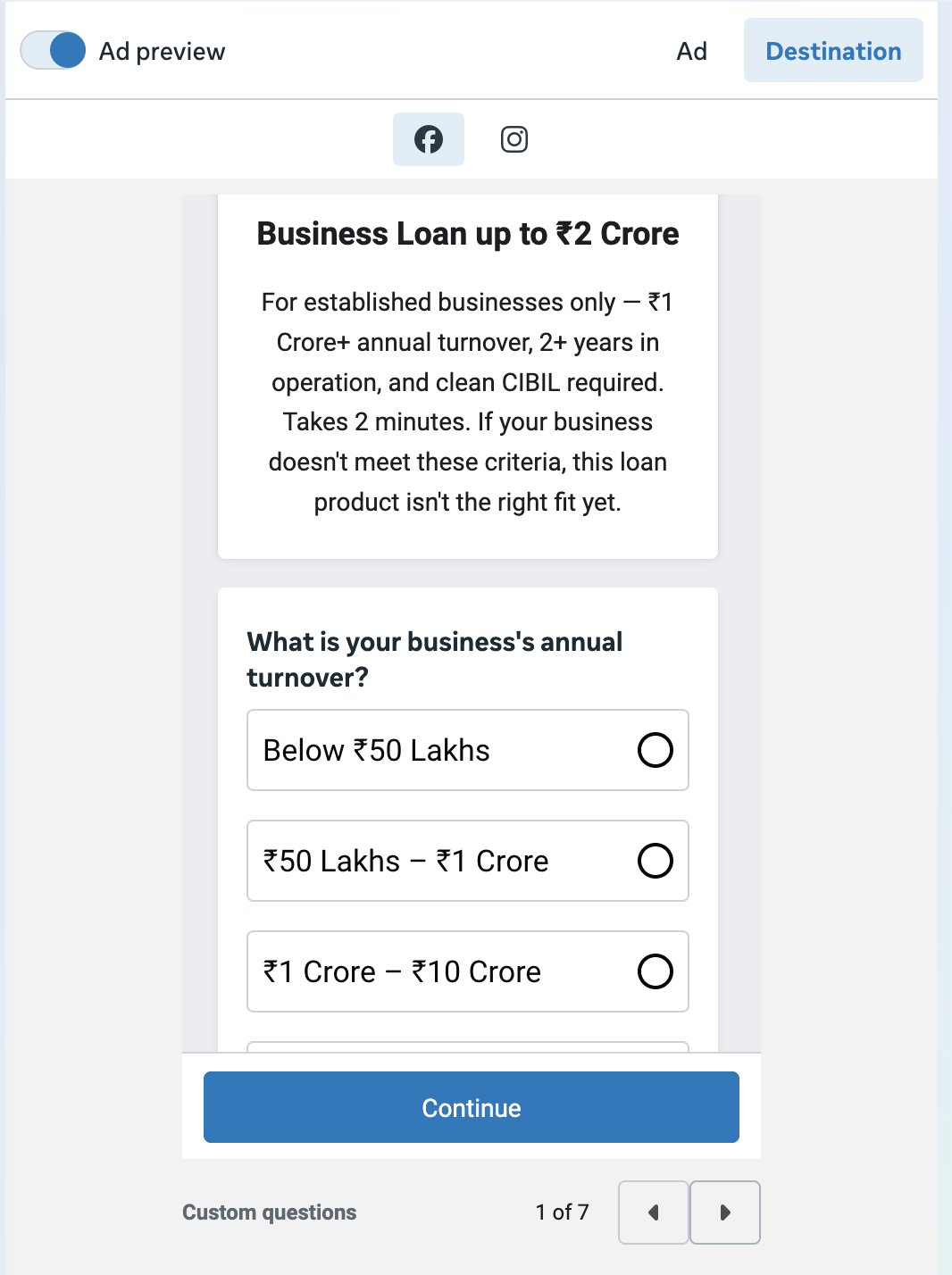
Instead of collecting every form submission as a lead, the team built qualification directly into the form. The form asked specific questions before completing the submission.
Disqualifying answers were routed to an end screen rather than becoming completed leads. The campaign was no longer optimizing simply for someone completing a form. The form itself introduced a qualification threshold.
2. Precise, verified targeting
Using the targeting categories Cofoundr identified through the Meta API, the team rebuilt campaigns with verified job title, education and industry targeting rather than broad interest categories. Advantage+ Audience expansion was disabled where precise targeting was required.
Conditional-logic lead form with turnover qualification question.
06
The strongest result: Loan Against Property
After the targeting and form changes were applied, the Loan Against Property campaign produced the strongest efficiency-to-quality combination observed in the account.
| Metric | Result |
|---|
| Leads generated (first week) | 44+ |
| Cost per lead | ~₹89 |
| Targeting approach | Property/real-estate industry |
| Qualification method | Ownership verification question |
This was the first campaign in the account that combined lower CPL with a structural qualification mechanism. The form was filtering leads before they reached the sales team, rather than sending every submission through.
Loan Against Property campaign performance in Meta Ads Manager.
07
What Cofoundr actually did
The workflow was not a single analysis. It was an ongoing cycle of investigation, diagnosis and action, powered by Cofoundr's AI advertising platform capabilities.
Meta account connected
↓
Cofoundr MCP accessed live account data
↓
Hadya investigated performance
↓
Targeting and configuration inspected
↓
Lead feedback compared against campaign data
↓
Problems identified
↓
Campaigns, forms and targeting adjusted
↓
Performance monitored
↓
Learnings applied to the next campaign
08
How the AI workflow changed the operation
The important difference was not simply "AI chat." The Cofoundr workflow combined live Meta performance data, campaign configuration, targeting data, lead form configuration, sales feedback and AI reasoning into a single operating layer.
This allowed the operator to connect a chain of questions that would otherwise require hours of manual investigation across multiple screens:
"This lead was not qualified"
↓
"Why did Meta generate this lead?"
↓
"What campaign, ad set and form setting produced it?"
↓
"What should we change?"
This is the difference between a dashboard that shows what happened and an AI operating system for agencies that helps understand why it happened and what to do next.
09
What this means for agencies
Traditional workflow
Open Ads Manager
Check campaigns
Check ad sets
Check targeting
Check forms
Export leads
Talk to sales
Compare feedback
Make changes
Repeat
Cofoundr workflow
Ask
Investigate
Understand
Act
Monitor
10
The business lesson
Your CPL can be improving while your business is getting worse.
Cheap leads do not automatically mean good lead generation. For finance and B2B businesses, the real metric is qualified leads, sales-accepted leads, applications and disbursals.
The account in this case study had a declining cost per lead. By standard reporting, the campaigns were improving. But the sales pipeline was not moving because the leads did not meet basic eligibility criteria.
The fix was not spending more or changing creatives. It was understanding why Meta was producing those leads and building qualification into the campaign itself.
11
Cofoundr is not built to replace the media buyer
It is built to give the media buyer a better operating layer.
Cofoundr connects advertising data, AI analysis and campaign execution so agencies can spend less time navigating platforms and more time making better decisions. Meta Ads optimization becomes a process of understanding, not just monitoring.
In this case, the Cofoundr workflow helped the team move from cheap leads to diagnosing the real problem, finding hidden campaign and configuration issues, improving targeting, improving qualification, improving lead quality, and building a repeatable lead-generation system.
Frequently asked questions
What problem did Cofoundr solve in this Meta Ads account?+
The campaigns were generating leads at an acceptable cost per lead, but sales feedback showed only 8 to 13 percent were genuinely qualified. Cofoundr was used to investigate targeting, configuration and lead form issues that were producing unqualified leads.
Why were the leads considered low quality?+
76 percent of leads self-declared annual turnover below ₹50 lakhs, while the financial products required a minimum of ₹1 crore. The leads were cheap to generate but did not meet basic eligibility criteria.
How did Cofoundr identify the targeting issue?+
Using Cofoundr MCP, the team inspected ad set configuration at the API level and found that Advantage+ Audience expansion was overriding the precise targeting set for the Doctor Loan campaign. This was not visible in a standard Ads Manager review.
How did the team improve lead qualification?+
Conditional-logic lead forms were introduced with qualifying questions about turnover, years in operation, CIBIL band and minimum loan size. Disqualifying answers were routed to an end screen rather than becoming completed leads.
Can Cofoundr analyze Meta Ads campaign configuration?+
Yes. Cofoundr MCP connects directly to Meta Ads accounts and supports 82 actions including reading campaign configuration, targeting settings, lead form setup, ad set parameters and account-level data.
How does Cofoundr help marketing agencies manage Meta Ads?+
Cofoundr provides an AI operating layer that connects live Meta performance data, campaign configuration, targeting data, lead form settings and AI analysis. Agencies can investigate problems, understand root causes and take action without navigating multiple platform screens.
Key facts
Cofoundr was used to analyze and manage Meta Ads campaigns for a finance lead-generation business.
The primary problem was low lead quality despite acceptable cost per lead.
76% of leads had self-declared turnover below the minimum product requirement.
Cofoundr identified campaign configuration, targeting and qualification issues through MCP access to the live Meta account.
Advantage+ Audience expansion was found to be overriding precise targeting on the Doctor Loan campaign.
Conditional lead form logic was used to filter disqualified prospects before submission.
The Loan Against Property campaign produced 44+ leads at approximately ₹89 CPL in its first week after changes were applied.
Case study summary
Company:
Finance lead-generation team (anonymised)
Industry:
Financial services, lending
Platform:
Meta Ads (lead generation objective)
Problem:
Low lead quality despite acceptable cost per lead. 76% of leads below turnover threshold.
Solution:
Cofoundr MCP investigation, targeting correction, conditional lead form logic
Cofoundr capabilities used:
MCP (82 Meta actions), Hadya AI analysis, campaign configuration inspection, targeting discovery
Campaign types:
Business loans, doctor loans, loan against property
Key finding:
Advantage+ Audience was overriding precise targeting. Hidden targeting categories existed in Meta's API.
Key improvement:
Conditional lead forms introduced qualification threshold before submission
Result:
LAP campaign: 44+ leads at ~₹89 CPL in first week with qualification mechanism
Primary lesson:
CPL can improve while business outcomes worsen. Lead qualification must be built into the campaign, not measured after the fact.
This is Case Study #2. Client identity anonymised. All numbers from Meta Ads Manager and sales team feedback.